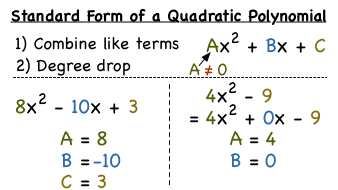
Standard Form Of Quadratic Equation. Therefore, the standard form of a quadratic equation can be written as: Ax2 + bx + c = 0 ; The standard form is ax² + bx + c = 0 with a, b, and c being constants, or numerical coefficients, and x is an unknown variable. The standard form of a quadratic equation looks like this: A, b and c are known values. Where x represents an unknown, and a, b, and c represent known numbers, where a ≠ 0. It is missing x2 (in other words a=0, which means it can't be quadratic). This one is not a quadratic equation: Have a play with it. A quadratic equation is an equation of the second degree, meaning it contains at least one term that is squared. In algebra, a quadratic equation (from the latin quadratus for square) is any equation that can be rearranged in standard form as. One absolute rule is that the first constant a cannot be a. Write the vertex form of a quadratic function. Using vertex form to derive standard form. If a = 0, then the equation is linear, not quadratic, as there is no.
Standard Form Of Quadratic Equation - If The Quadratic Polynomial = 0, It Forms A Quadratic Equation.
Quadratic Standard And Vertex Form Lessons Tes Teach. Write the vertex form of a quadratic function. Using vertex form to derive standard form. One absolute rule is that the first constant a cannot be a. Where x represents an unknown, and a, b, and c represent known numbers, where a ≠ 0. A quadratic equation is an equation of the second degree, meaning it contains at least one term that is squared. A, b and c are known values. Ax2 + bx + c = 0 ; It is missing x2 (in other words a=0, which means it can't be quadratic). This one is not a quadratic equation: The standard form of a quadratic equation looks like this: Therefore, the standard form of a quadratic equation can be written as: Have a play with it. The standard form is ax² + bx + c = 0 with a, b, and c being constants, or numerical coefficients, and x is an unknown variable. If a = 0, then the equation is linear, not quadratic, as there is no. In algebra, a quadratic equation (from the latin quadratus for square) is any equation that can be rearranged in standard form as.
Also, as the previous example has shown, when we get two real distinct solutions we will be able to eliminate so, to solve we'll first need to clear denominators and get the equation in standard form.
Here we have provided you with a table showing examples of different forms of quadratic equations the factored form of a quadratic equation tells us the roots of a quadratic equation. A root of a quadratic is also called a zero. Quadratic formula explained with pictures, examples and step by step problems | math warehouse. The standard form of a quadratic equation looks like this: What do you want to calculate? If given any quadratic equation in standard form, ax2+bx+c=0. Try to convert a standard quadratic equation to form. Write the vertex form of a quadratic function. This substitution transforms the equation into a familiar quadratic equation in terms of u which, in this case, can be solved by factoring. Define and graph a quadratic equation. Where x is an unknown variable and a,b,c are numerical coefficients here, a ≠ 0 because if it. A, b and c are known values. Here we have provided you with a table showing examples of different forms of quadratic equations the factored form of a quadratic equation tells us the roots of a quadratic equation. This calculator will solve your problems. A, b and c are some numbers and x is variable. How to solve quadratic equations using the quadratic formula. It makes a parabola (a u shape) when graphed on a coordinate plane. (see topic 7 of precalculus, question 2.) Quadratic equation in one variable is the equation with standard form color(purple)(ax^2+bx+c=0). The standard form is ax² + bx + c = 0 with a, b, and c being constants, or numerical coefficients, and x is an unknown variable. Solving a quadratic equation and finding the roots of quadratic equation. Because, as we will see, at each root the value of the graph is 0. Also, the 2a in the denominator of the formula is warning: The standard form of a quadratic is $y=ax^2+bx+c$ because it expresses the coefficients of the powers of $x$. The properties of their graphs such as vertex and x and y intercepts are explored interactively using an html5 applet. A quadratic equation is an equation of the second degree, meaning it contains at least one term that is squared. The standard form of quadratic equation is ax² + bx + c = 0. One absolute rule is that the first constant a cannot be a. These values are called the solutions of the equation. The quadratic formula is used to find two solutions for quadratic equations, which are second order equations, with one term raised to the second power. In this activity, students explore the standard form of a quadratic equation, y = ax 2 + bx + c.
A Quadratic Equation Is Written In The Standard Form Ppt Video Online Download - More Lessons For Basic Algebra Math Worksheets.
Solving Quadratic Equations By The Quadratic Formula Chilimath. A quadratic equation is an equation of the second degree, meaning it contains at least one term that is squared. Write the vertex form of a quadratic function. It is missing x2 (in other words a=0, which means it can't be quadratic). One absolute rule is that the first constant a cannot be a. In algebra, a quadratic equation (from the latin quadratus for square) is any equation that can be rearranged in standard form as. Have a play with it. Using vertex form to derive standard form. Ax2 + bx + c = 0 ; A, b and c are known values. Therefore, the standard form of a quadratic equation can be written as: The standard form of a quadratic equation looks like this: Where x represents an unknown, and a, b, and c represent known numbers, where a ≠ 0. If a = 0, then the equation is linear, not quadratic, as there is no. This one is not a quadratic equation: The standard form is ax² + bx + c = 0 with a, b, and c being constants, or numerical coefficients, and x is an unknown variable.
Quadratic Equations Zeros Standard Form And Factored Form Cut Paste - This Makes It Easy To Apply The This Isn't Limited To Quadratics.
Quadratic Formula Equation How To Use Examples. Write the vertex form of a quadratic function. Ax2 + bx + c = 0 ; One absolute rule is that the first constant a cannot be a. It is missing x2 (in other words a=0, which means it can't be quadratic). A quadratic equation is an equation of the second degree, meaning it contains at least one term that is squared. This one is not a quadratic equation: In algebra, a quadratic equation (from the latin quadratus for square) is any equation that can be rearranged in standard form as. Where x represents an unknown, and a, b, and c represent known numbers, where a ≠ 0. Have a play with it. The standard form is ax² + bx + c = 0 with a, b, and c being constants, or numerical coefficients, and x is an unknown variable.
Math Lab Graphing Quadratic Equations In Standard Form Fill Online Printable Fillable Blank Pdffiller : (see topic 7 of precalculus, question 2.)
Parabolas In Standard Intercept And Vertex Form Video Lesson Transcript Study Com. The standard form is ax² + bx + c = 0 with a, b, and c being constants, or numerical coefficients, and x is an unknown variable. If a = 0, then the equation is linear, not quadratic, as there is no. In algebra, a quadratic equation (from the latin quadratus for square) is any equation that can be rearranged in standard form as. A quadratic equation is an equation of the second degree, meaning it contains at least one term that is squared. Where x represents an unknown, and a, b, and c represent known numbers, where a ≠ 0. One absolute rule is that the first constant a cannot be a. Using vertex form to derive standard form. This one is not a quadratic equation: A, b and c are known values. Have a play with it. Write the vertex form of a quadratic function. Ax2 + bx + c = 0 ; The standard form of a quadratic equation looks like this: It is missing x2 (in other words a=0, which means it can't be quadratic). Therefore, the standard form of a quadratic equation can be written as:
Standard Form Of A Quadratic Equation And Coefficients - Because, As We Will See, At Each Root The Value Of The Graph Is 0.
Solving Quadratic Equations By The Quadratic Formula Chilimath. The standard form is ax² + bx + c = 0 with a, b, and c being constants, or numerical coefficients, and x is an unknown variable. Write the vertex form of a quadratic function. Have a play with it. Where x represents an unknown, and a, b, and c represent known numbers, where a ≠ 0. Using vertex form to derive standard form. If a = 0, then the equation is linear, not quadratic, as there is no. A, b and c are known values. A quadratic equation is an equation of the second degree, meaning it contains at least one term that is squared. This one is not a quadratic equation: In algebra, a quadratic equation (from the latin quadratus for square) is any equation that can be rearranged in standard form as. It is missing x2 (in other words a=0, which means it can't be quadratic). The standard form of a quadratic equation looks like this: One absolute rule is that the first constant a cannot be a. Ax2 + bx + c = 0 ; Therefore, the standard form of a quadratic equation can be written as:
5 3 Vertex Form Of Quadratic Functions : 3:18 Brian Mclogan 23 318 Просмотров.
Transformation Of Quadratic Equation In Standard Form Geogebra. In algebra, a quadratic equation (from the latin quadratus for square) is any equation that can be rearranged in standard form as. Using vertex form to derive standard form. It is missing x2 (in other words a=0, which means it can't be quadratic). If a = 0, then the equation is linear, not quadratic, as there is no. This one is not a quadratic equation: The standard form is ax² + bx + c = 0 with a, b, and c being constants, or numerical coefficients, and x is an unknown variable. The standard form of a quadratic equation looks like this: A, b and c are known values. Have a play with it. A quadratic equation is an equation of the second degree, meaning it contains at least one term that is squared. One absolute rule is that the first constant a cannot be a. Ax2 + bx + c = 0 ; Write the vertex form of a quadratic function. Therefore, the standard form of a quadratic equation can be written as: Where x represents an unknown, and a, b, and c represent known numbers, where a ≠ 0.
Graphing Quadratic Functions In Standard Form - This Is The Currently Selected Item.
Graphing Quadratic Functions In Standard Form. The standard form of a quadratic equation looks like this: One absolute rule is that the first constant a cannot be a. Using vertex form to derive standard form. Where x represents an unknown, and a, b, and c represent known numbers, where a ≠ 0. Have a play with it. This one is not a quadratic equation: Therefore, the standard form of a quadratic equation can be written as: If a = 0, then the equation is linear, not quadratic, as there is no. It is missing x2 (in other words a=0, which means it can't be quadratic). Ax2 + bx + c = 0 ; In algebra, a quadratic equation (from the latin quadratus for square) is any equation that can be rearranged in standard form as. The standard form is ax² + bx + c = 0 with a, b, and c being constants, or numerical coefficients, and x is an unknown variable. A, b and c are known values. Write the vertex form of a quadratic function. A quadratic equation is an equation of the second degree, meaning it contains at least one term that is squared.
Write Quadratic Equation In Standard Form With Given Roots At P And Q Youtube . A Quadratic Equation Is An Equation That Can Be Written As Ax ² + Bx + C Where A ≠ 0 In Other Words, A Quadratic Equation Must Have A Squared Term As Its Highest Power Examples Of Quadratic Equations.
Quadratic Equation In Standard Form With Roots Geogebra. It is missing x2 (in other words a=0, which means it can't be quadratic). If a = 0, then the equation is linear, not quadratic, as there is no. The standard form is ax² + bx + c = 0 with a, b, and c being constants, or numerical coefficients, and x is an unknown variable. This one is not a quadratic equation: A, b and c are known values. Ax2 + bx + c = 0 ; Write the vertex form of a quadratic function. One absolute rule is that the first constant a cannot be a. The standard form of a quadratic equation looks like this: Where x represents an unknown, and a, b, and c represent known numbers, where a ≠ 0. In algebra, a quadratic equation (from the latin quadratus for square) is any equation that can be rearranged in standard form as. Have a play with it. Using vertex form to derive standard form. Therefore, the standard form of a quadratic equation can be written as: A quadratic equation is an equation of the second degree, meaning it contains at least one term that is squared.
Write Quadratic Equation In Standard Form With Given Roots At P And Q Youtube , The Standard Form Of A Quadratic Is $Y=Ax^2+Bx+C$ Because It Expresses The Coefficients Of The Powers Of $X$.
State The Standard Form Of A Quadratic Equation In One Variable Solve Method Of Perfect Square. Where x represents an unknown, and a, b, and c represent known numbers, where a ≠ 0. This one is not a quadratic equation: Write the vertex form of a quadratic function. The standard form of a quadratic equation looks like this: Ax2 + bx + c = 0 ; Using vertex form to derive standard form. In algebra, a quadratic equation (from the latin quadratus for square) is any equation that can be rearranged in standard form as. The standard form is ax² + bx + c = 0 with a, b, and c being constants, or numerical coefficients, and x is an unknown variable. If a = 0, then the equation is linear, not quadratic, as there is no. Have a play with it. Therefore, the standard form of a quadratic equation can be written as: It is missing x2 (in other words a=0, which means it can't be quadratic). A quadratic equation is an equation of the second degree, meaning it contains at least one term that is squared. A, b and c are known values. One absolute rule is that the first constant a cannot be a.
Introduction To Quadratics Ppt Download , There Are Times When We Are Stuck Solving A Quadratic Equation Of The Form A{X^2} + Bx + C = 0 In Order Use The Quadratic Formula, The Quadratic Equation That We Are Solving Must Be Converted Into The Standard Form, Otherwise, All.
Convert Quadratic Equation To Standard Form Example 1 Youtube. This one is not a quadratic equation: A quadratic equation is an equation of the second degree, meaning it contains at least one term that is squared. In algebra, a quadratic equation (from the latin quadratus for square) is any equation that can be rearranged in standard form as. It is missing x2 (in other words a=0, which means it can't be quadratic). If a = 0, then the equation is linear, not quadratic, as there is no. Therefore, the standard form of a quadratic equation can be written as: Have a play with it. One absolute rule is that the first constant a cannot be a. Ax2 + bx + c = 0 ; Write the vertex form of a quadratic function. Using vertex form to derive standard form. The standard form is ax² + bx + c = 0 with a, b, and c being constants, or numerical coefficients, and x is an unknown variable. The standard form of a quadratic equation looks like this: A, b and c are known values. Where x represents an unknown, and a, b, and c represent known numbers, where a ≠ 0.
13 1 Introduction To Quadratic Equations Ppt Video Online Download : Ax2 + Bx + C = 0 ;
Write Quadratic Equation In Standard Form With Given Roots At P And Q Youtube. Using vertex form to derive standard form. This one is not a quadratic equation: A, b and c are known values. Have a play with it. A quadratic equation is an equation of the second degree, meaning it contains at least one term that is squared. The standard form of a quadratic equation looks like this: The standard form is ax² + bx + c = 0 with a, b, and c being constants, or numerical coefficients, and x is an unknown variable. In algebra, a quadratic equation (from the latin quadratus for square) is any equation that can be rearranged in standard form as. One absolute rule is that the first constant a cannot be a. Where x represents an unknown, and a, b, and c represent known numbers, where a ≠ 0. Ax2 + bx + c = 0 ; If a = 0, then the equation is linear, not quadratic, as there is no. Therefore, the standard form of a quadratic equation can be written as: Write the vertex form of a quadratic function. It is missing x2 (in other words a=0, which means it can't be quadratic).
